Background
What is the I-Ching?
The I-Ching (易經, Yìjīng) is also known as the Book of Changes: an ancient system of 64 hexagrams that offers insight into what is happening in your life right now. You ask a question and receive an image in return, one that lets you look at your situation afresh.
When I first started exploring it, I also wanted to know where the book came from. Its core is called the Zhōuyì (周易), the Changes of Zhou, and it is roughly three thousand years old. Nobody can date it precisely, as the texts were handed down and added to over many centuries. Later came the Ten Wings (十翼, Shí Yì), commentaries traditionally attributed to Confucius. That is how the I-Ching became one of the great classics of China, read by Taoists and Confucians alike, each from their own angle.
The idea underneath it is simple: everything is constantly in motion. Yin turns into yang and back again. Once you learn to recognise that movement, you can move along with it. For me this ties in seamlessly with what I experience in Qigong, where you never see Qi standing still either.
A hexagram is a figure of six lines stacked on top of each other. Each line is either solid (yang) or broken (yin). Six lines with two possibilities each give exactly 64 combinations. You read a hexagram from the bottom up, the way a plant grows.
Every hexagram is made up of two trigrams of three lines. There are eight trigrams, the bāguà (八卦), and they stand for the great forces of nature: heaven (乾, Qián), earth (坤, Kūn), thunder (震, Zhèn), water (坎, Kǎn), mountain (艮, Gèn), wind (巽, Xùn), fire (離, Lí) and lake (兌, Duì). So a hexagram is always a meeting of two forces. Water above fire is called Jì Jì (既濟), After Completion; fire above water is called Wèi Jì (未濟), Before Completion. You will find those two again in the zen stones at the bottom of this page.
A line can also be moving. Such a line turns into its opposite, and one hexagram then changes into another. That is where the name comes from: the book shows not only where you stand, but also where things are heading.
The quality of the answer starts with the question. I always take a moment to become still first, with a few calm breaths, so the question does not come from restlessness. An open question works better than a yes-or-no question. Asking “What do I need to see in this situation?” or “How do I deal with this?” gives the image room to show you something. Ask one question at a time, about a concrete situation, and write it down. That way you can read back later what you asked and what came up.
If you don’t recognise the answer straight away, let it rest for a while. Asking the same question again right away mostly leads to confusion. An answer often falls into place later, sometimes days later.
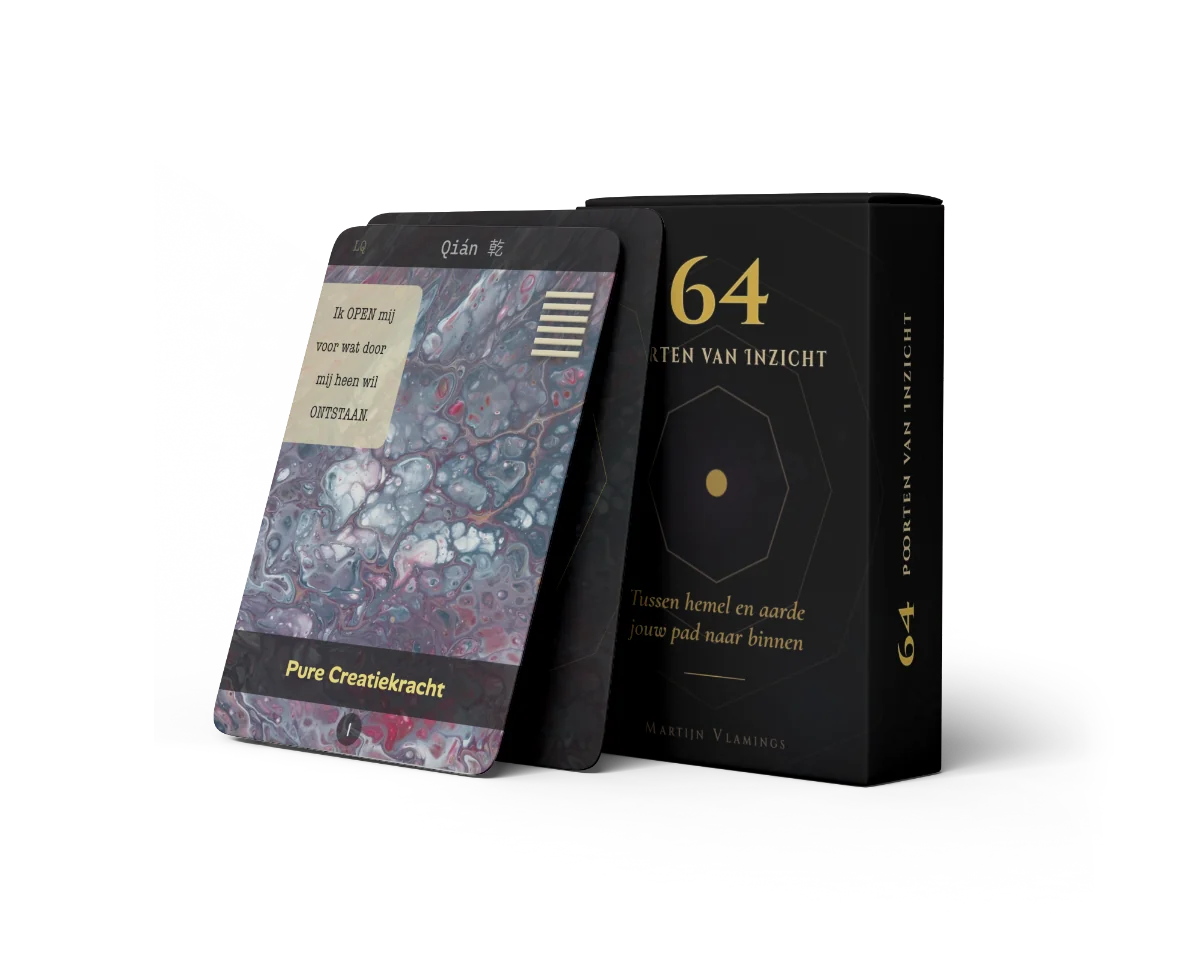
Traditionally you throw three coins six times, or count with fifty yarrow stalks. With the deck it is simpler: you hold your question in mind and draw a single card.
Many people know the I-Ching as an oracle that predicts the future. I use it differently. To me, the book describes the moment you are in and the movement within it. What happens next also depends on what you do with that insight.
That is why I see it as a mirror. The answer helps you see more clearly, and the choice remains yours. Whether you hear an ancient wisdom speaking through the image or mainly your own intuition, I gladly leave to you.
The original texts carry enormous depth. But to be honest, I often found that it turned into a kind of puzzle. Old words, symbolism, translations of translations… so that you are mostly busy working out what is meant. And sometimes I felt something different from what was written. As if the essence had faded somewhere along the way.
This deck of cards grew out of that feeling.
This is not an attempt to improve the I-Ching, but to make its core easier to feel. I have distilled the texts to what is, for me, their essence, and translated each hexagram into a fluid art painting, intuitive and without fixed form,
so that it is not only something you read, but something you can experience directly. The deck comes with a book that explores each card in more depth, with a poem, an explanation, and a Qigong exercise or meditation,
so that the insight is not only understood, but also carries through into how you move, feel and see.
The intention is simple:
that you don’t have to search for the meaning,
but recognise it, and feel it touch you directly.